00
Author Open — Why a Surgeon Writes a Gospel
Page color follows the system setting until you choose light, dark, or sepia.
I love bones.
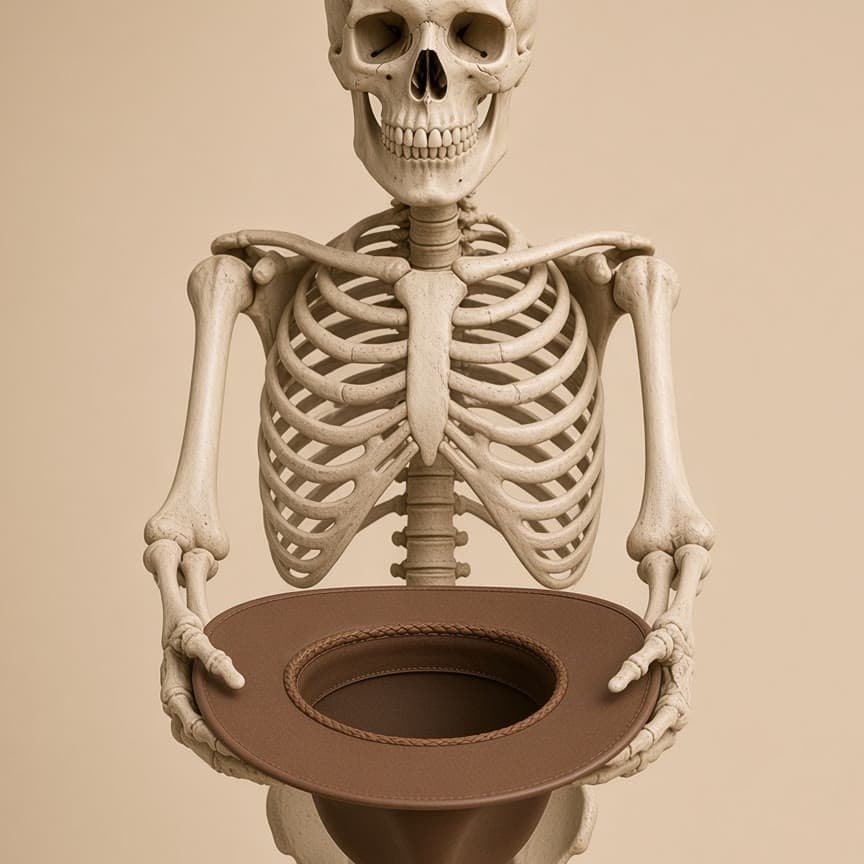
Not the Halloween plastic skeleton that never bled and never put in work. The living ones. The ones that take the weight of the world and let you exist. The ones that crack and still master gravity. The ones that house marrow like a factory and meet each other through cartilage like a bearing.
I am M. Chad Mahan, M.D. I like fixing broken bones. That is not branding. That is appetite. Bone work is honest. The tissue has a story that holds or it doesn't, and metal only buys time for biology to finish what metal can never become. I scrubbed into that honesty for years. I held fracture lines. I watched callus invent competence. I learned how often the real repair is not the implant. It is the living refusal to stay injured.
Fair warning about who is talking. I am the surgeon writing this book. Dr. Blakley, D.O., Speaker of Bone, is my own persona, the voice of the bone itself. From here on, he does the talking.
The Hard Years
The ossification phase of my life was hard. Not tragic-hard. No-foothold hard.
I struggled to fit in when I was young. "Gifted and curious" is the polite name. The truth was an insatiable mind with an unbreakable urge to discover, not to be handed answers. I had no patience for idle explanations. Things that were obvious to me stayed in contradiction with everyone else. I'm a doer. Rules and norms were hard to follow when the picture in my head was already past the room I was standing in. I was unhappy for a long time. I could see it all, except where I wanted to be.
Without a sense of contact, you can't act. The mind needed a hold.
Like a newborn's startle. Arms out until something catches. Life held me the way a nurse holds an infant who hasn't found the world yet. Then I started picking up what my teachers were putting down. Soon I was teaching my teachers.
That was orthopedics. Maybe this book is an answer to my own questions. Maybe yours. Maybe your patients'.
The Speaker
I am Dr. Blakley, D.O. Speaker of Bone. Been out of the game. Roaming open pastures. Ideas still fill the hours, and my skeleton holds the space. It hurts to see the joints and never again get my hands on them. I can't operate anymore. But I have thanks to give. To every teacher who put the map in my mind and the tools in my hands. To my bones, still arguing for continuity. To my cartilage, still buying me a quiet joint. To my skeleton, still carrying a day I no longer earn with my hands.
And I noticed something that should rearrange the room.
Brains love bones too.
Not as a feeling. As a structure: the brain depends on bone. A brain only gets a steady world because bone cases it, stacks it, and holds up the limbs that carry it through weather and work. Skull. Spine. Limbs. Quiet joints. Hearing lives in bone. Balance lives in bone. Thought rides on a frame. Soft genius needs hard architecture, or the genius is no match for a harsh, chaotic world.
Why It Sounds Like Scripture
You will notice this book has a rhythm. Lessons. Commandments. Call and response. "The bone teaches." That's on purpose.
People have always passed down what matters in a form they can remember. Long before writing, people painted stories on cave walls (Chapter 12 tells that one). A lesson sticks when it has a rhythm and a reason.
So here is the deal. This is a book of lessons, but every miracle in it is a mechanism. You can look each one up. You can test it. Where we are guessing, we say Our reading, and we tell you how someone could prove us wrong.
I test inputs and outputs. I always have. Since I was young I did what made sense, not what looked right to everyone else. That made me a difficult person to be around for some. I never grew out of it. I found a place to aim it, and that is how I did orthopedics.
That's why I loved it. You couldn't make it up. You study the actual problem, you see it on the film, and then you fix it with knowledge, with truth, and with your hands. Skeletal traction. Rotationplasty. Plates and screws. External fixators. Nails, locked or not. Talk about a hold. In very few fields can you see the problem, fix it yourself, and then watch it heal. I belonged there.
I listen to the laws of physics. Load. Failure. Repair. The rest is costume.
The Nodes
Once you see that, you start seeing the nodes.
A node, in this book, is a load point: a place where bone meets bone and force passes through. A hip. A knee. An ankle. A thumb. The brain can steer which nodes get used. It can't run the whole package. Bone and soft tissue manage themselves, often quietly, often for the better, sometimes at a cost. Steering is one job. Upkeep is another. Same body.
I spent a career helping nodes. Places where the world's random chaos gets met and turned into a usable force. Places where a hip or a knee stops being "a joint" and becomes the difference between a life that can walk into its own day and a life that can't.
We are human. Nature made us, on one small planet in an enormous universe. Think of all the stupid, petty things people do to each other and to themselves. Then look at what we are. A beautiful machine, working hard to keep up with your course. It isn't fighting you. It's so completely with you that it may be too good at it. It carries the load quietly and keeps going, often without a word. If it could be built again, it might speak up sooner. But it's with you to the end.
We are a byproduct of evolution, and an upgrade. Not bestowed. Not a gift from the clouds. Upright walking, fast and far. Stories and tricks shared, good and bad. No user's manual. That's what this book is trying to be: not the manual, but the habit of reading what is.
The Answer Above the Science
Use your gifts fully. Work toward mastery. Then teach it. Be good to family and friends, and help who you can. Things will break. Repair is part of the cycle, and then the next one begins.
The skeleton won't solve every problem on Earth. Nothing will. But it will show you a way of solving problems that works: look, test, keep what holds, teach it on.
The masterpiece is already within reach. You can feel it under your hand.
— M. Chad Mahan, M.D., with Dr. Blakley, D.O., Speaker of Bone